TRENDING

Friday, 6 November 2026
----------------------
26 Jumada Al-Awwal 1448 AH
After his party's significant midterm losses, President Donald Trump declared the Oval Office and adjacent rooms a national monument. This move, framed as preservation, is a complex interplay of executive power, political defiance, and a president's attempt to cement his personal legacy.
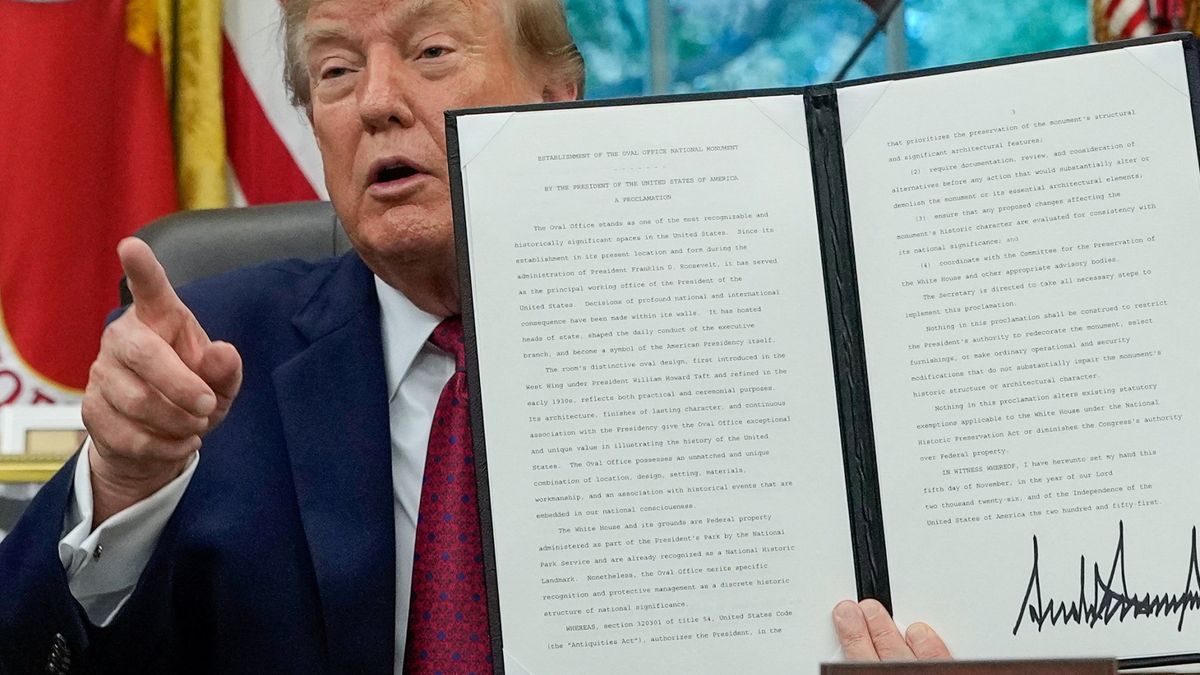
On November 5, 2026, United States President Donald Trump signed a proclamation designating the Oval Office, the Cabinet Room, and the Outer Oval Office as a national monument. This action, taken from behind his desk while wearing a red 'VETO' baseball cap, marked his first official move since his party suffered sweeping losses in the recent midterm elections, which will grant Democrats control of Congress starting in January. The proclamation aims to prevent future significant alterations to these spaces, which the president has extensively redesigned during his second term.
President Trump's declaration of the Oval Office as a national monument is a potent display of executive power, yet one fraught with inherent limitations and symbolic defiance. The power to designate national monuments stems from the Antiquities Act of 1906, a century-old law that grants presidents broad authority to protect areas of historic or scientific interest. However, this power is not absolute, and its application here reveals a complex interplay of presidential prerogative, legislative checks, and a leader's attempt to control his narrative.
At its core, the proclamation is an executive action, meaning it can be revised or revoked by a successor president through a new executive order. This critical detail underscores the temporary nature of such declarations, a reality that President Trump himself has exploited multiple times. During his first term, he dramatically downsized two major national monuments in Utah, only for them to be fully restored by President Joe Biden. He repeated this pattern in his second term, again reversing Biden's restorations. This history demonstrates that while a president can unilaterally establish or alter monuments, the next occupant of the White House holds the power to undo those decisions. The current proclamation, therefore, serves less as an immutable decree and more as a statement of intent, a challenge to future administrations, and a political message to his base.
The timing of this action is particularly telling. Coming directly after significant electoral defeats that will shift control of Congress to the Democrats, the proclamation can be interpreted as a defiant gesture. It's a move to assert control and legacy in the face of diminishing political power. By declaring the Oval Office a monument, Trump attempts to enshrine his personal aesthetic changes – the golden makeover, the gilded frames, the burnished wood carvings – as part of the nation's historical fabric, making them harder for a successor to casually erase. This is a subtle yet significant manipulation of the concept of
Source referenced: ALJAZEERA
This brief was synthesized by our Editorial Engine and reviewed by The Ground Narrative team.