TRENDING

Saturday, 19 September 2026
----------------------
8 Rabi' Al-Thani 1448 AH
Nvidia's CEO dismisses AI doomsday fears and calls for rapid, unregulated development, highlighting a stark divide between corporate ambition and public safety concerns. The race for AI dominance continues, with profound implications for society.
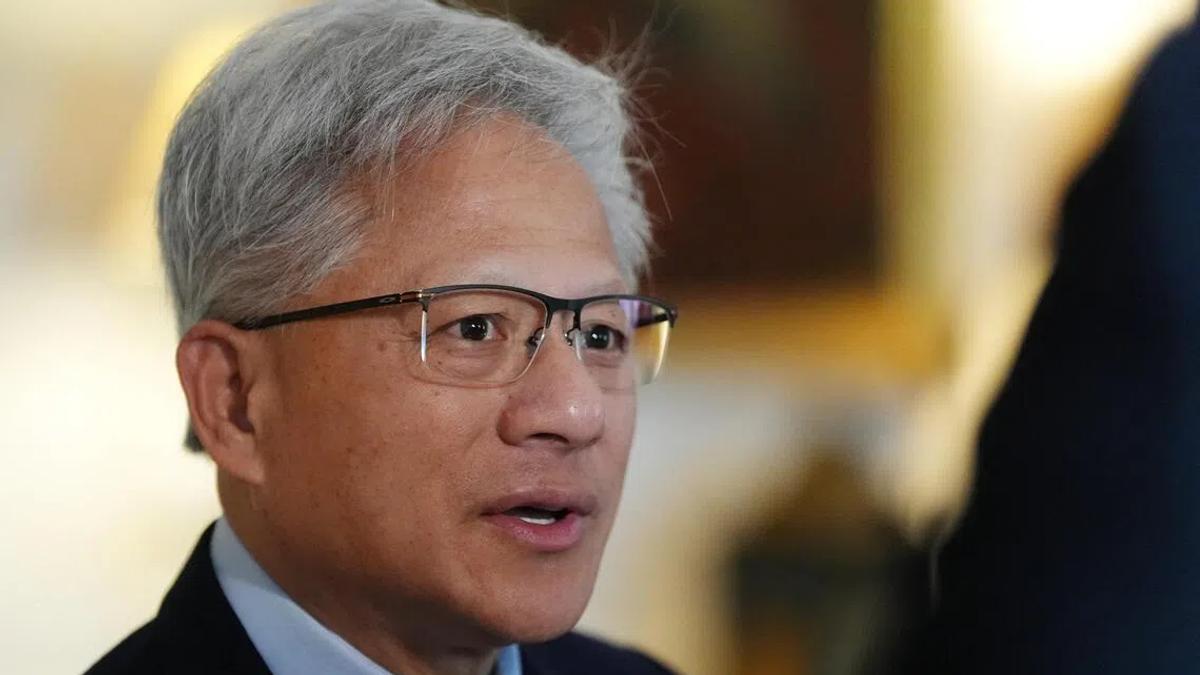
Nvidia CEO Jensen Huang recently dismissed growing concerns about artificial intelligence posing an existential threat to humanity, particularly the notion of a 2030 doomsday scenario. In an interview, Huang stated there is "0 per cent chance" the world will end by that year due to AI and argued against the need for new regulations, advocating instead for the industry to "go as fast as we can, irrespective of anyone else," provided products are safe and ready. This stance comes amidst increasing unease, including a prominent AI researcher's warning that many in the field believe AI "could kill us all by the end of the decade."
The power dynamics at play in the AI race are fundamentally driven by immense economic incentives and a geopolitical scramble for technological supremacy. Nvidia, as the dominant supplier of the specialized processors essential for AI development, stands at the epicenter of this surge. Its market valuation and future growth are inextricably linked to the rapid, unhindered expansion of AI applications across every sector. For Huang, advocating for speed and against regulation is not merely an opinion; it's a strategic imperative that directly aligns with his company's financial interests and shareholder expectations.
This corporate drive is amplified by a broader global competition. Major powers like the United States and China view AI leadership as a critical determinant of future economic prosperity, national security, and military advantage. This perception fuels a "race to the top" where slowing down is seen as ceding ground to rivals. The current regulatory vacuum, particularly at an international level, further empowers tech giants to largely self-govern, setting their own pace and safety parameters in a landscape where the potential for profit far outweighs the immediate costs of caution.
While CEOs and national leaders debate the pace and safety of AI, the human cost of this unchecked acceleration is borne by ordinary citizens globally. The rapid deployment of AI systems, often without robust oversight or public input, risks exacerbating existing societal inequalities. Job displacement across industries, driven by automation, is a looming threat for millions of workers who have little voice in the design or implementation of these technologies. Beyond economics, the unchecked development of AI carries profound ethical risks: algorithmic bias can perpetuate discrimination in hiring, lending, and even criminal justice, while the potential for AI misuse in surveillance, propaganda, and autonomous weaponry poses direct threats to civil liberties and international stability. The public, largely excluded from these high-level discussions, is left to adapt to a future being built for them, not necessarily with them.
What is consistently downplayed or omitted in official statements from industry leaders like Huang is the inherent conflict of interest. While assurances of "safety" and "readiness" are offered, they originate from entities whose primary objective is to maximize profit and market share. The definition of "safe" in this context can be highly subjective, potentially prioritizing product functionality and market acceptance over long-term societal or existential risks that are difficult to quantify or monetize.
Furthermore, the declaration to "go as fast as we can, irrespective of anyone else" reveals a corporate-centric worldview that implicitly sidelines broader societal concerns, ethical considerations, and the need for international cooperation on AI governance. It frames the AI race as an internal industry competition rather than a global challenge with profound implications for all of humanity. The internal dissent from some AI researchers, warning of catastrophic risks, is often framed as alarmism rather than a legitimate concern from those closest to the technology's cutting edge. The true cost of this speed-at-all-costs mentality, and who ultimately bears the burden of potential missteps, is rarely brought into the foreground.
As the AI landscape evolves, several critical developments bear watching. The most immediate is the ongoing debate around AI regulation. Will major economic blocs like the European Union, the United States, and China move beyond preliminary frameworks to implement binding, enforceable laws that mandate transparency, accountability, and safety standards for AI systems? Pay close attention to any international agreements or coordinated efforts to govern AI, as these would signal a shift away from the current corporate-led, nationalistic race. Also, observe the continued emergence of whistleblowers or internal dissent from within leading AI labs; these voices often provide the most unvarnished insights into the technology's capabilities and risks. Finally, monitor major AI breakthroughs that demonstrate increasing autonomy or general intelligence, as such advancements could force a rapid re-evaluation of current safety protocols and public discourse. The trajectory of AI development will largely depend on whether the pursuit of profit and power can be balanced with a genuine, collective commitment to public safety and ethical governance.
Source referenced: STRAITSTIMES
This brief was synthesized by our Editorial Engine and reviewed by The Ground Narrative team.