TRENDING

Saturday, 19 September 2026
----------------------
8 Rabi' Al-Thani 1448 AH
Nearly three years after a devastating Israeli airstrike, Gazans hold a mass funeral for 112 members of the Al-Hassayna clan, whose remains were finally recovered from the ruins of their homes. This delayed burial highlights the ongoing human toll and the deep scars left by a conflict where entire families can be erased in an instant.
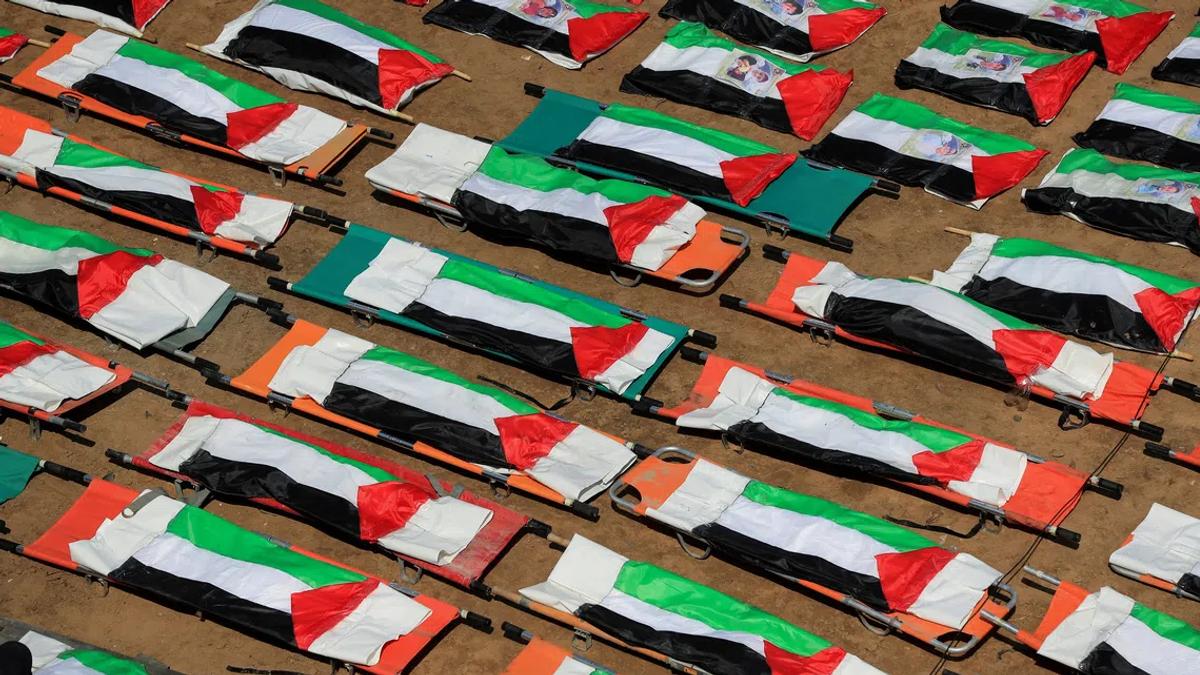
In early August 2026, the decomposed remains of 112 individuals, identified as members of the Al-Hassayna clan, were laid to rest in Gaza City. This mass funeral, described by Palestinian authorities as the largest of the ongoing conflict, came nearly three years after an Israeli airstrike on November 22, 2023, brought down a cluster of apartment buildings in the Sabra neighborhood, killing 308 members of the extended family as they slept. While approximately half of the victims were recovered and buried shortly after the incident, 153 bodies remained beneath the rubble until a recent 17-day recovery operation finally unearthed 112 more.
The power dynamics at play in this tragedy are stark. Israel, possessing overwhelming military superiority and air power, executed the strike that decimated the Al-Hassayna clan. The immediate aftermath saw the Israeli military offer no public statement or account of the specific incident in November 2023, a pattern that underscores a broader lack of transparency and accountability for individual strikes amidst a large-scale conflict. This absence of official explanation leaves a vacuum, filled only by the physical devastation and the testimonies of survivors. Post-October 2023, Israeli forces gained control over significant portions of Gaza, further complicating recovery efforts and dictating where and when such operations can occur. Palestinian authorities and civil defense teams, operating with severely limited resources and under constant duress, are left to manage the humanitarian fallout, painstakingly sifting through ruins in the remaining accessible areas. Their capacity to respond to the scale of destruction is fundamentally constrained by the ongoing conflict and the imbalance of power.
The human cost is borne most acutely by the surviving members of the Al-Hassayna clan and the broader Gazan population. Omar Al-Hassayna, a survivor who lost his wife, four sons, and four grandchildren in the strike, encapsulates the profound, enduring grief. His experience highlights how the conflict doesn't just claim individual lives but can obliterate entire family lines, a particularly devastating consequence in a society where extended families often live in close proximity. The delayed recovery of bodies, nearly three years later, denies families the immediate closure essential for grieving. For the estimated 8,000 other Palestinians still believed to be under rubble across Gaza, the Al-Hassayna funeral is a grim reminder of their own unresolved losses. The sheer scale of death – over 73,000 confirmed Palestinian fatalities – combined with the destruction of homes and infrastructure, means that the fabric of Gazan society is being systematically torn apart, leaving a generation to grapple with unimaginable trauma and loss.
What is routinely downplayed or omitted by powerful actors, particularly by the Israeli military, is the granular, human-level impact of individual strikes. The narrative often focuses on broader strategic objectives or the necessity of military operations, while the specific, devastating consequences for non-combatant families like the Al-Hassaynas are sidelined. The lack of an immediate public explanation for the Sabra strike in 2023 is not an isolated incident but indicative of a broader pattern where the details of civilian casualties are often obscured or delayed. Furthermore, the immense logistical and emotional burden of recovering and identifying decomposed remains, requiring forensic evidence and survivor memories, is a testament to the scale of destruction that extends far beyond initial casualty counts. The world's attention often moves on, but for those on the ground, the war continues in the painstaking search for the dead and the struggle to bury them with dignity, a process that can take years and is hampered by a severe lack of equipment and access.
Moving forward, several critical aspects bear watching. The ability of Gaza's Civil Defence to continue recovery efforts in the remaining accessible areas, particularly given their stated need for significant heavy machinery, will determine how many more families might find a semblance of closure. The long-term psychological and social impact on a population that has endured such profound loss and displacement will be immense and will shape the region for decades. Any future international investigations or demands for accountability regarding specific incidents like the Sabra strike could shift the narrative, though past precedent suggests this is a difficult path. Finally, the ongoing territorial control exerted by Israeli forces will continue to dictate the practicalities of rebuilding, recovery, and the daily lives of Gazans, influencing everything from humanitarian aid access to the very possibility of reconstructing shattered communities.
Source referenced: STRAITSTIMES
This brief was synthesized by our Editorial Engine and reviewed by The Ground Narrative team.