TRENDING

Tuesday, 8 September 2026
----------------------
26 Rabi' Al-Awwal 1448 AH
US-backed talks on Venezuela's political future begin, notably excluding popular opposition leader Maria Corina Machado. This analysis examines the power dynamics, the human cost of exclusion, and the unstated objectives shaping the nation's path forward.
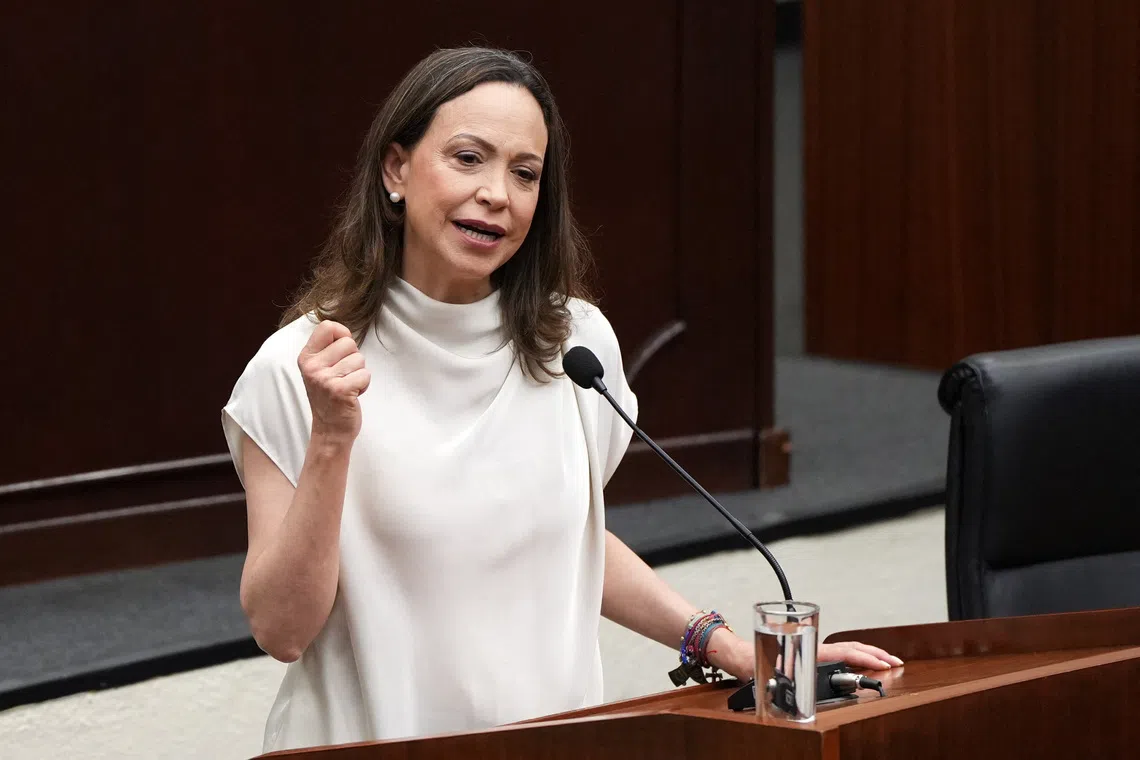
US-backed negotiations between Venezuela's interim government and a faction of the opposition are set to begin on August 1st. These talks aim to overhaul the country's political system and pave the way for future elections. Significantly, Maria Corina Machado, widely recognized as Venezuela's most popular opposition figure and a Nobel Peace Prize laureate, has been excluded from the opposition delegation, which is led by Dinorah Figuera, head of the 2015 National Assembly cohort still recognized by the United States.
The United States holds significant leverage in these negotiations, having removed Nicolas Maduro and installed Delcy Rodriguez as acting president. Washington's influence is evident in its explicit backing of Figuera's faction, citing her leadership of the "last democratically-elected assembly from 2015" as a basis for legitimacy. This strategic choice allows the US to shape the opposition's representation, ostensibly to ensure a process leading to "free and fair elections." For the interim Venezuelan government, the primary incentive is the lifting of remaining US sanctions, which have crippled the nation's economy. The US has previously demonstrated a willingness to ease these sanctions in exchange for political concessions.
However, this architecture of power sidesteps a critical internal dynamic: the deep divisions within Venezuela's opposition. While the US claims Machado lacks sufficient support, her popularity and Nobel recognition suggest a significant public mandate. The US's stated goal of "stabilizing and economically recovering" Venezuela before elections implies a controlled, phased transition, rather than an immediate democratic contest. This approach allows powerful external actors to dictate the terms and pace of change, ostensibly offering "security" to opposition figures but also limiting their autonomy and the breadth of their representation.
The most immediate human cost of these talks falls on the Venezuelan populace, particularly those who identify with Maria Corina Machado's movement. Her exclusion means a significant segment of the country's political will is effectively unrepresented at the negotiating table. This risks undermining the legitimacy of any eventual agreement in the eyes of ordinary citizens, fostering cynicism and distrust in a process meant to restore democracy.
Furthermore, the ongoing economic hardship, exacerbated by sanctions and political instability, continues to impact daily life. While sanctions relief is a stated goal, the slow, controlled pace of political reform means continued uncertainty for businesses and families. The mention of devastating twin earthquakes in June, which Machado vowed to return to help with, serves as a stark reminder that while political elites negotiate, the public grapples with immediate, life-threatening crises, often with limited resources and fractured leadership. The promise of "fair elections" rings hollow if the process to achieve them excludes popular voices and prolongs the period of political limbo.
What is being downplayed or omitted by powerful actors, particularly the US, is the extent of their direct intervention in shaping Venezuela's internal political landscape. While US Secretary of State Marco Rubio states the US is there to "facilitate, but not dictate," the active selection of Dinorah Figuera to lead the opposition delegation and the repeated sidelining of Maria Corina Machado contradict this narrative. The US is not merely facilitating; it is actively curating the participants, prioritizing a specific legalistic interpretation of legitimacy (the 2015 assembly) over popular appeal.
This approach risks creating a "negotiated democracy" where the outcome is largely predetermined by external powers and a select few internal actors, rather than emerging organically from the will of the Venezuelan people. The argument that Machado "does not have enough support" or that "it is not the right time" for her return, despite her popularity, serves to justify a more controlled, less unpredictable path to transition. The underlying tension is between a process designed for stability and a process designed for genuine, broad-based representation.
Readers should closely watch the immediate outcomes of these talks. Will they genuinely lead to the restoration of democratic institutions, the release of political prisoners, and a clear timetable for free and fair elections, as Machado herself has stipulated? Or will they result in a more limited agreement primarily focused on sanctions relief, without addressing the fundamental questions of political representation and legitimacy?
Also critical will be Maria Corina Machado's response. While she has stated she will not "stand in the way of real progress," her continued exclusion could galvanize her supporters outside the official process, potentially creating a parallel political dynamic that challenges the legitimacy of the US-backed negotiations. Finally, observe the public's reaction within Venezuela. The success of these talks, in the long run, will hinge not just on agreements made in Washington or Caracas, but on whether the Venezuelan people perceive the process as truly representing their aspirations for a democratic future.


