TRENDING

Thursday, 17 September 2026
----------------------
6 Rabi' Al-Thani 1448 AH
A renewed confrontation between the United States and Iran has rapidly escalated, drawing Iraq and Yemen deeper into a spreading regional conflict. This analysis examines the power dynamics, human costs, and global economic vulnerabilities exposed by the intensifying hostilities.
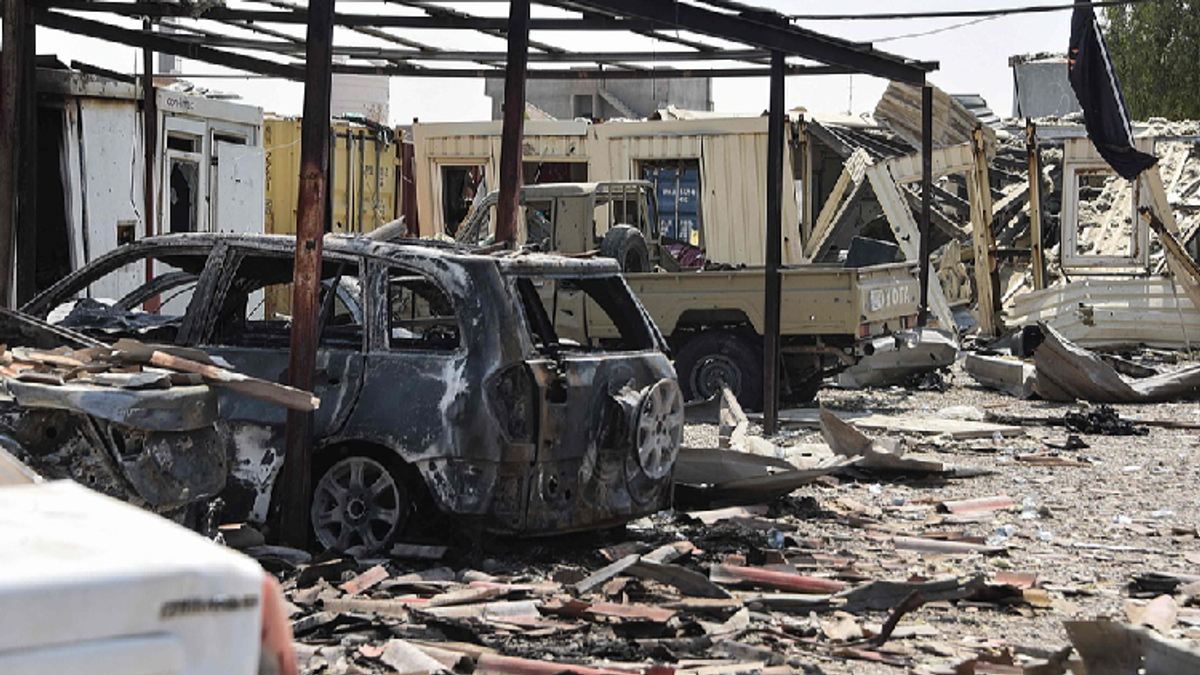
Recent weeks have seen a significant escalation of hostilities in the Middle East, marked by a renewed confrontation between the United States and Iran. This resurgence has rapidly drawn in other regional actors, with fighting resuming in Yemen and Iraqi Shiite militias becoming increasingly involved. US-Saudi strikes have targeted militia positions in Iraq, while a recent drone attack on Egypt signals the conflict's widening geographical scope and its direct threat to critical international waterways.
This escalation is rooted in the long-standing geopolitical rivalry between the United States and Iran, a contest for regional influence that often plays out through proxy forces. For Iran, supporting groups like the Houthis in Yemen and various Shiite militias in Iraq provides strategic depth and leverage against US and Saudi interests, while demonstrating its capacity to disrupt regional stability. For the US and Saudi Arabia, these strikes are presented as efforts to counter Iranian-backed threats to their security and global shipping lanes, reinforcing their regional dominance.
The Houthi blockade of the Bab el-Mandeb Strait, ostensibly triggered by disputes over flights to Sana'a, is a clear demonstration of their capacity to exert pressure on international maritime trade, a significant bargaining chip. Iraq's central government, caught between its powerful neighbor Iran and its security partner the US, struggles to assert sovereignty over its own territory, particularly concerning the autonomous Shiite militias. This internal fragmentation amplifies the region's vulnerability to external intervention and proxy warfare. The mention of Ukraine's support for the US position also highlights an emerging convergence of seemingly disparate global crises, where regional conflicts are increasingly intertwined with broader international security challenges and alliance structures.
The immediate and most devastating cost is borne by the ordinary citizens of Yemen and Iraq, who find themselves once again caught in the crossfire of larger power struggles. Years of conflict have already decimated infrastructure, displaced millions, and created severe humanitarian crises in both nations. Renewed fighting means more civilian casualties, further disruption of basic services, and a deepening cycle of poverty and instability.
Beyond the direct conflict zones, the pressure on vital shipping lanes like the Bab el-Mandeb Strait and the Strait of Hormuz has a ripple effect on global economies. Disruptions to energy supplies and international trade routes translate into higher costs for consumers worldwide, impacting everything from fuel prices to food staples. For countries like Egypt, reliant on Suez Canal revenues, the threat to navigation presents a severe economic challenge, potentially forcing difficult strategic choices that could further destabilize the region and impact its own population.
What official statements from Washington, Tehran, and Riyadh often omit is the profound and long-term erosion of state sovereignty and civilian trust in the region. While the US and Saudi Arabia frame their actions as counter-terrorism or defensive measures, they rarely acknowledge the extent to which their interventions, historical and present, contribute to the very instability they claim to address. Similarly, Iran's support for non-state actors, while strategically effective, comes at the cost of empowering factions that undermine national governments and prolong internal conflicts.
The Iraqi government's public opposition to foreign strikes on its territory, juxtaposed with its inability to control powerful militias, highlights a critical power vacuum that no party wants to fully confront. All powerful actors downplay the human toll of prolonged proxy warfare, preferring to focus on strategic gains or security imperatives. The narrative of "ceasefire violations" or "militia assistance" simplifies complex local grievances and the desperate struggle for survival faced by millions, reducing them to mere tactical maneuvers in a larger game.
The immediate future will hinge on whether the current trajectory of geographical expansion can be halted. Watch for any attempts at de-escalation, particularly through back-channel diplomacy involving regional mediators like Pakistan, Qatar, or Oman, though their influence is currently limited by the rapid spread of the conflict. The stability of existing, fragile agreements, such as the 2022 Yemen ceasefire, will be a key indicator; their complete collapse could open new, unpredictable fronts.
Crucially, monitor the impact on global energy markets and shipping. Any prolonged or significant disruption to the Bab el-Mandeb Strait or the Strait of Hormuz will trigger international alarm and likely prompt more forceful responses from global powers. The degree to which Egypt is drawn into the conflict, especially concerning the Suez Canal, will be a critical flashpoint. Finally, observe how the US-Iran nuclear program negotiations, currently at a standstill, might be affected by or used as leverage in this escalating regional crisis.
Source referenced: CGTN
This brief was synthesized by our Editorial Engine and reviewed by The Ground Narrative team.


