TRENDING
Thursday, 17 September 2026
----------------------
6 Rabi' Al-Thani 1448 AH
Georgia's government is using new 'anti-vulgarity' laws to prosecute citizens for online speech, effectively silencing dissent under the guise of promoting public order. This crackdown follows a period of democratic backsliding, raising concerns about the country's trajectory away from European integration.
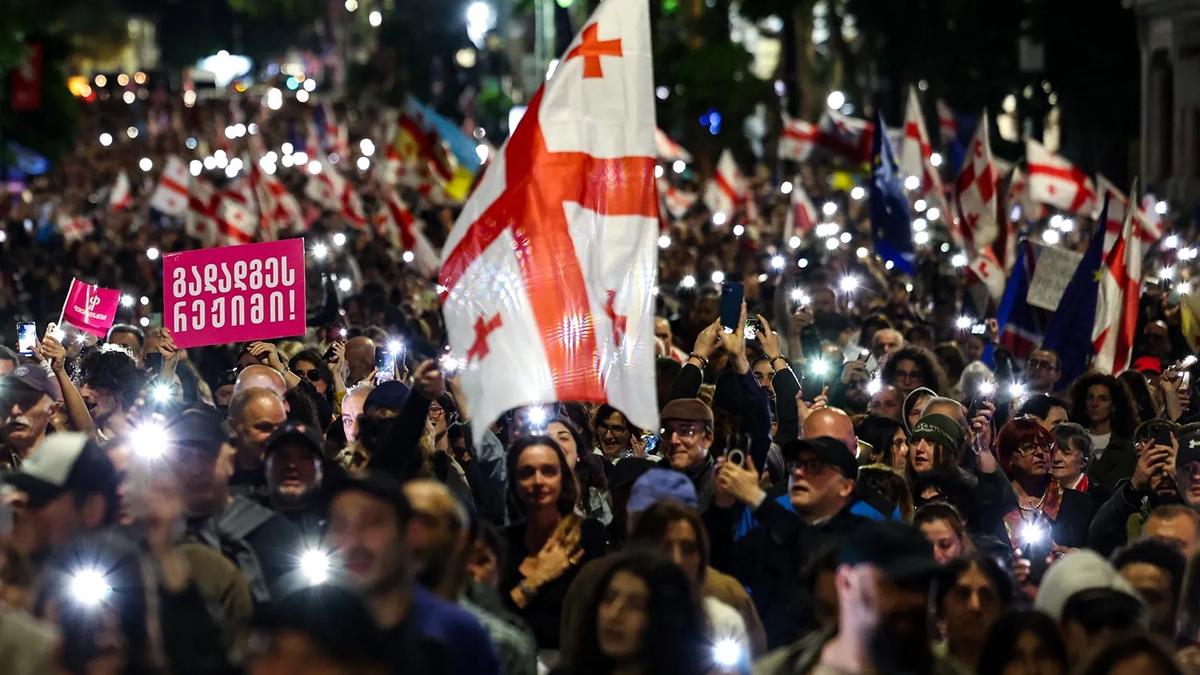
In Georgia, a new campaign against online 'vulgarity' is rapidly transforming the nation's legal landscape. Citizens like business owner Zurab Chitaia and activist Giorgi Akhobadze have faced fines and even administrative detention for critical remarks made on social media, often containing expletives directed at the ruling Georgian Dream party or its officials. The Interior Ministry has established a 10-person Division for Combating Hate Speech, actively monitoring public statements and proactively identifying alleged violations, leading to hundreds of cases being sent to court.
This crackdown on speech is not an isolated incident but a calculated move within a broader strategy to consolidate power. Following disputed parliamentary elections in October 2024 and the suspension of EU accession talks, the Georgian Dream government has moved to dismantle political opposition and suppress public dissent. By amending the Soviet-era Code of Administrative Offenses, they have weaponized vague notions of 'verbal insults' and 'taunting' to target critics. The creation of a dedicated monitoring unit ensures constant surveillance, while courts act as enforcers, often ignoring legal thresholds for public order disturbances or relevance to official duties. This bureaucratic machinery provides a veneer of legality to what is, in practice, a systematic silencing campaign. The government's strategic use of a recent European Court of Human Rights ruling, which upheld a fine against a Georgian citizen for sexually explicit language, further lends a false sense of international legitimacy to their domestic actions.
The immediate human cost of these policies falls on ordinary Georgians. Business owners face significant fines, potentially jeopardizing their livelihoods. Activists and journalists are subjected to administrative detention, creating a chilling effect that discourages public discourse and self-expression. The threat of legal action forces self-censorship, eroding the vibrant public sphere essential for a functioning democracy. Even those who insult opposition figures are brought to court, creating a false equivalence that wastes taxpayer money and serves primarily to legitimize the state's overreach. As opposition leader Tamar Chergoleishvili noted, citizens become 'collateral damage' in a larger political game, their lives disrupted by a system designed to silence any voice that challenges the status quo. The psychological toll of living under constant surveillance, where a casual online remark can lead to legal consequences, is immeasurable.
The Georgian government frames its actions as a moral crusade to 'cleanse' the political environment of 'toxic hostility' and 'eradicate hate speech.' Prime Minister Irakli Kobakhidze insists the state acts 'without double standards' to stabilize the country. What is conspicuously absent from this narrative is the deliberate political targeting. The 'civility' campaign is selectively enforced, with opposition figures receiving maximum penalties while those who insult them often get off with warnings or lighter fines. The true intent is not to foster civility but to eliminate effective opposition, stifle critical reporting, and prevent public mobilization. The ECHR ruling, which focused on specific sexually explicit language in a widely viewed video, is being broadly misrepresented by state propaganda as a blanket endorsement of Georgia's new speech restrictions, downplaying the narrow scope of the court's decision and its emphasis on context.
Observers should watch for several key developments. Firstly, the escalation of penalties: Will administrative detentions become more frequent or longer? Secondly, the response of civil society: Will the public continue to defy the crackdown, as seen with the mass insults against Kremlin propagandists? Thirdly, the reaction from international bodies and Western partners: Will the EU, in particular, apply stronger pressure on Tbilisi, potentially impacting future integration prospects? The government's continued trajectory away from democratic norms could further isolate Georgia on the international stage, but the immediate battle for free expression will be fought in the courts and on the streets by its own citizens.
Source referenced: FOREIGNPOLICY
This brief was synthesized by our Editorial Engine and reviewed by The Ground Narrative team.


