TRENDING

Thursday, 17 September 2026
----------------------
6 Rabi' Al-Thani 1448 AH
China's donation of a lunar sample to the UN is framed as a gesture of international cooperation, but it also underscores the intensifying competition for prestige and resources in outer space. This move highlights Beijing's growing influence in shaping the future of space governance and scientific access.
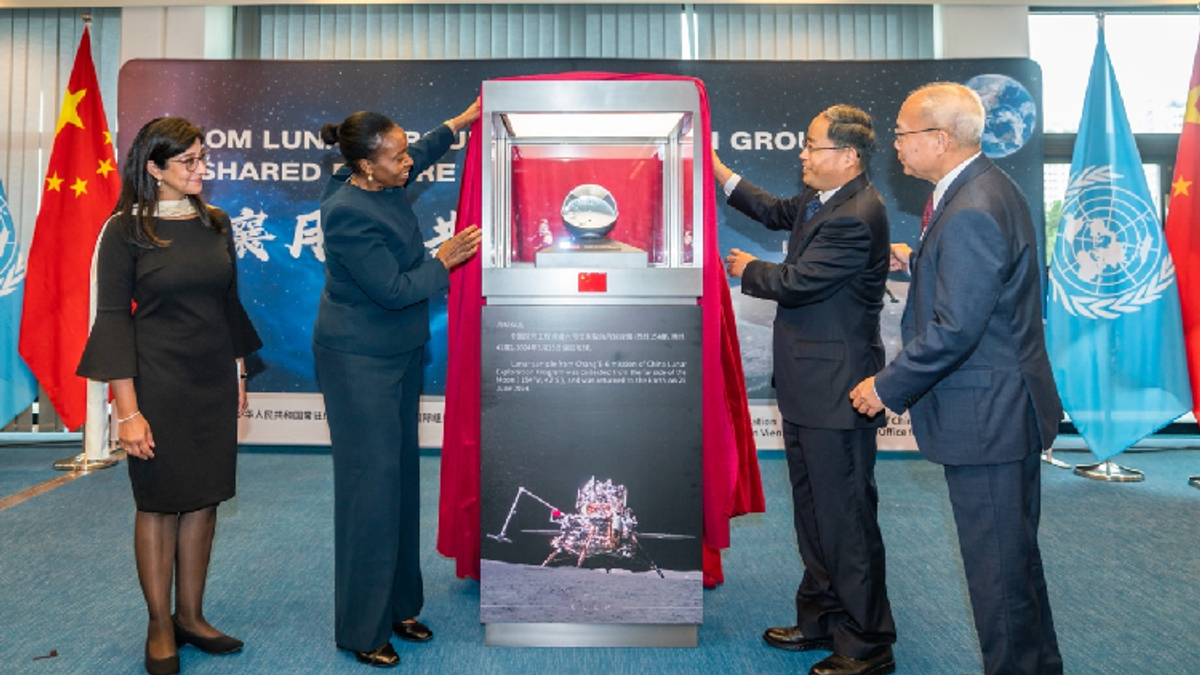
China, through its historic Chang'e-6 mission, successfully retrieved nearly two kilograms of lunar soil from the far side of the moon's South Pole-Aitken Basin – a scientific and engineering first for humanity. This unprecedented material was then formally donated to the United Nations in Vienna, with Chinese officials emphasizing international cooperation and the peaceful use of space. The sample is intended for permanent public display and scientific study under UN auspices, marking a significant moment in global space diplomacy.
This donation is far more than a simple scientific gesture; it's a calculated maneuver in the rapidly evolving landscape of space power. China's successful mission demonstrates its advanced capabilities in deep-space exploration, firmly placing it at the forefront alongside the United States and other established spacefaring nations. By donating the sample to the UN, Beijing strategically positions itself as a responsible global actor committed to multilateralism, subtly contrasting with the U.S.-led Artemis Accords, which some nations perceive as a framework that might favor American interests. This act significantly strengthens China's soft power, asserting its vision for "a community with a shared future for humanity" in outer space. This vision implies a more inclusive, UN-centric governance model over bilateral or bloc-specific agreements, subtly challenging the historical dominance of the U.S. and Russia in setting space norms. It signals China's intent to be a rule-maker, not merely a rule-follower, in the cosmic domain. The symbolic value of being the first to retrieve a sample from the moon's far side, then sharing it globally, greatly enhances China's scientific prestige and leadership on the world stage.
While space exploration often appears distant from daily human concerns, the intensifying competition for celestial achievements carries tangible, albeit indirect, costs. The massive investments in national space programs, while yielding technological advancements that can benefit humanity, divert substantial financial and intellectual resources. These resources could otherwise be directed towards addressing pressing terrestrial challenges such as climate change mitigation, global poverty, public health crises, or sustainable development initiatives. For nations without advanced space capabilities, the promise of a "shared future" often translates into reliance on the technological giants, potentially exacerbating existing global inequalities and creating new dependencies. Furthermore, the unspoken militarization of space, an undercurrent to all these advancements, poses a long-term risk to global stability. The potential for weaponization or the creation of vast debris fields could render crucial orbital pathways unusable for future generations, disrupting critical satellite services essential for modern life, from communication and navigation to weather forecasting and disaster response. The human cost here is less about direct suffering and more about opportunity costs and the potential for future conflict or exclusion in a vital new domain.
What is conspicuously downplayed in the celebratory speeches about "common ground" and a "shared future" is the fierce, underlying competition for lunar resources and strategic advantage. The moon, particularly its polar regions, is believed to hold significant reserves of water ice, which is crucial for future long-duration missions, potential human settlements, and even as a source of rocket fuel. The South Pole-Aitken Basin, from which China collected its sample, is of particular scientific interest for its unique geological composition and potential resource deposits. While China speaks of sharing, its pioneering actions also secure a *de facto* claim to advanced capabilities and early presence in these critical regions. The donation to the UN, while a magnanimous gesture, also serves to legitimize China's leading presence in these areas, subtly challenging any future exclusive claims or access by other powers. The rhetoric of "peaceful use" often masks the inherent dual-use nature of space technology, where civilian advancements can readily serve military objectives – a reality rarely acknowledged in diplomatic statements or public ceremonies.
The coming years will be crucial in revealing whether this gesture truly fosters greater international cooperation or merely sets the stage for intensified competition in space. Watch closely for how other major spacefaring nations, particularly the United States and its allies, respond to China's UN-centric approach to space governance. Will the U.S.-led Artemis Accords gain broader acceptance, or will China's multilateral push attract more developing nations and shape alternative frameworks? Observe the next steps in lunar resource exploration – who establishes permanent bases, who develops extraction technologies, and how the legal frameworks for resource ownership are debated or, more likely, bypassed through *fait accompli*. The trajectory of space debris mitigation efforts and the development of anti-satellite weapons will also be critical indicators of whether humanity's "shared dream" in space descends into a new arena of conflict or truly becomes a realm of collaborative progress for all.
Source referenced: CGTN
This brief was synthesized by our Editorial Engine and reviewed by The Ground Narrative team.


