TRENDING

Monday, 19 October 2026
----------------------
8 Jumada Al-Awwal 1448 AH
China's top diplomat recently laid out a comprehensive vision for Asia at a regional security summit, advocating for an 'Asian community with a shared future.' This move signals Beijing's intent to reshape the continent's security and economic architecture, challenging traditional Western influence.
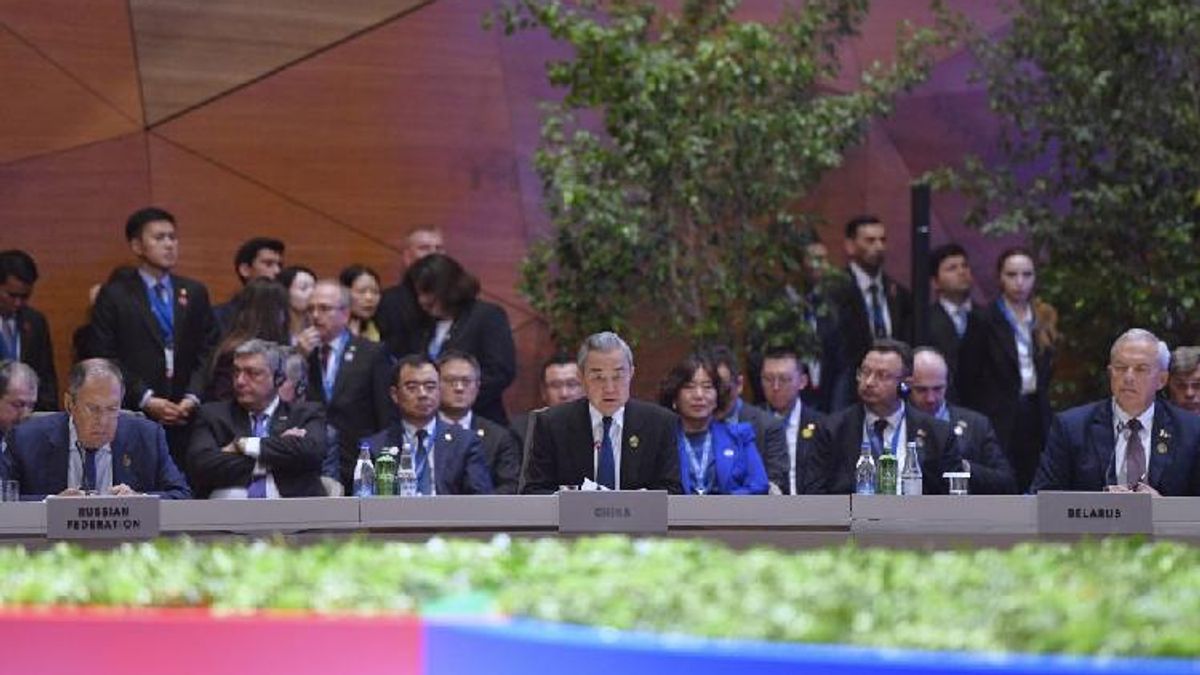
Chinese Foreign Minister Wang Yi recently attended the Seventh Summit of the Conference on Interaction and Confidence Building Measures in Asia (CICA) in Baku, Azerbaijan, on October 15, 2026. During the summit, Wang Yi put forward four key proposals aimed at boosting cooperation among CICA member states. These proposals centered on safeguarding peace and stability, promoting prosperity and revitalization, fostering exchanges among civilizations, and improving global governance, all framed within the concept of an "Asian community with a shared future." On the sidelines, Wang Yi engaged in significant bilateral meetings with high-level officials from Israel, Russia, Bahrain, Turkey, and Palestine, underscoring a broader diplomatic push.
China's engagement with CICA is a calculated move to reconfigure the power balance in Asia and, by extension, globally. The organization, initially conceived in the early 1990s as a forum for dialogue, is being leveraged by Beijing as a vehicle to advance its vision of a regional order less reliant on, and potentially free from, Western influence. This is not merely about cooperation; it is about establishing a new set of norms and a framework for interaction that aligns with China's strategic interests.
Wang Yi's call to reject a "Cold War mentality" and "bloc confrontation" is a direct rhetorical challenge to the existing security architecture in Asia, which largely involves United States-led alliances and partnerships such as the Quad (involving US, India, Japan, and Australia). By advocating for "common, comprehensive, cooperative and sustainable security," China seeks to delegitimize these alliances as divisive and instead promote a model where security is managed internally by Asian nations. This approach implicitly positions China as the leading voice in defining what "Asian security" entails, effectively pushing for a regional security framework where external powers have diminished roles. The emphasis on "Asian problems should ultimately be addressed by the people of Asia" is a clear signal to Washington to reduce its footprint.
The second proposal, focusing on prosperity and revitalization through the Belt and Road Initiative (BRI), highlights China's strategy of using economic leverage to foster political alignment. By aligning high-quality BRI cooperation with national development initiatives, Beijing aims to deepen economic dependencies and integrate member states into a China-centric economic sphere. Safeguarding an open environment for cooperation, advancing trade liberalization, and ensuring stable transport corridors are all facets of this strategy. This not only provides much-needed infrastructure and investment for many developing Asian nations but also creates a web of economic interests that can be translated into political influence, solidifying China's position as the indispensable economic partner in the region.
China's push for "Asian values of peace, cooperation, openness and inclusiveness" is a soft power play designed to create a distinct regional identity that contrasts with Western liberal democratic norms. Respecting countries' "independent choices of development paths and governance models" subtly endorses authoritarian or semi-authoritarian regimes, providing a shield against external criticism regarding human rights or democratic deficits. This narrative seeks to legitimize diverse political systems within Asia under a banner of cultural relativism, thereby bolstering the stability of regimes friendly to Beijing and reducing the perceived legitimacy of Western-style democracy promotion. The call to reinvigorate the United Nations while simultaneously building a more "efficient, inclusive and resilient governance system in Asia" suggests a desire to reshape global governance from within, while also creating parallel regional structures that can operate with greater autonomy from Western-dominated institutions.
The bilateral meetings on the sidelines of the summit are equally telling. Meeting with both Israeli and Palestinian foreign ministers allows China to position itself as a neutral, responsible global power capable of engaging with all parties in complex conflicts, contrasting with the perceived partisan role of the United States in the Middle East. Engaging with Russia, a key strategic partner, reinforces the emerging anti-Western alignment. Meetings with Turkey and Bahrain further extend China's diplomatic reach into the Middle East and Central Asia, regions critical for energy security and BRI connectivity. These engagements demonstrate China's ambition to be a comprehensive global player, not just an Asian one.
While China's proposals for regional stability and prosperity sound appealing, the underlying power dynamics carry significant human costs that are often overlooked in official narratives.
The emphasis on "Asian values" and respecting "independent choices of development paths and governance models" can, in practice, be used to justify the suppression of universal human rights and democratic aspirations. For ordinary citizens in CICA member states, this rhetoric can translate into less international scrutiny for authoritarian practices, limited freedom of speech, restricted political participation, and a shrinking space for civil society. Regimes may feel empowered to crack down on dissent, knowing that a powerful patron like China will prioritize state sovereignty and non-interference over human rights concerns, leaving populations vulnerable to state overreach.
The promise of "prosperity and revitalization" through Belt and Road projects often comes with significant financial risks. Many developing nations, eager for infrastructure, take on substantial loans that can lead to unsustainable debt burdens. When countries struggle to repay, they may be forced to cede control over strategic assets, such as ports or critical infrastructure, to China. This economic dependency can compromise national sovereignty and limit a country's ability to make independent policy decisions, ultimately impacting the livelihoods and long-term economic stability of its people. The benefits of these projects often flow disproportionately to Chinese companies and laborers, rather than fostering local job creation or genuine technology transfer.
While promoting "peace and stability," China's vision for "Asian solutions for Asian problems" could lead to a regional order where the concerns of smaller nations are overshadowed by the interests of larger, more powerful states, particularly China. This could mean less recourse for countries facing pressure from Beijing on issues like territorial disputes or trade practices. Furthermore, the focus on state-to-state cooperation often sidelines the voices of non-state actors, indigenous groups, and marginalized communities, whose concerns might be deemed secondary to broader geopolitical stability or economic development, as defined by powerful governments.
Official statements from Beijing and the CICA summit often present a polished narrative of mutual cooperation and shared prosperity. However, beneath the surface, several critical elements are either downplayed, omitted, or framed in a way that obscures their true strategic intent.
China's repeated denunciation of a "Cold War mentality" and "bloc confrontation" is not merely a call for peace; it is a direct and deliberate rhetorical attack on the United States' alliance system in Asia. By framing US security partnerships with countries like Japan, South Korea, Australia, and the Philippines as relics of a bygone era or as instigators of conflict, Beijing seeks to delegitimize these defensive arrangements. The untold story here is that these alliances are often viewed by member states as crucial counterweights to China's own growing military assertiveness and territorial claims, particularly in the South China Sea and concerning Taiwan. China's rhetoric downplays the legitimate security concerns of its neighbors and attempts to dismantle security structures that do not place Beijing at the center.
While advocating for "peace and stability" and "common security," China's own actions in the region often contradict this narrative. The rapid militarization of artificial islands in the South China Sea, ongoing border disputes with India, persistent pressure on Taiwan, and the severe human rights situation in Xinjiang and Hong Kong are rarely, if ever, acknowledged in such forums. The call for "respecting countries' independent choices of development paths" is presented as a principle of non-interference, yet China has frequently used economic coercion against countries like Australia and Lithuania over political disagreements. The untold story is the inherent contradiction between China's stated principles of peaceful coexistence and its increasingly assertive foreign policy and domestic governance practices.
The idea that "Asia's problems should ultimately be addressed by the people of Asia" sounds empowering, but it implicitly suggests that external perspectives or universal principles are irrelevant. This framing downplays the fact that many Asian nations still rely on external security guarantees or prefer a multi-polar security architecture that includes non-Asian powers to balance China's growing might. Furthermore, the CICA itself is a diverse group, and not all members share China's vision for a China-centric regional order. Countries like India, while part of CICA, also participate in the Quad and maintain strong ties with Western powers. The "consensus" reached in declarations often masks underlying strategic divergences and the reluctance of some members to fully embrace Beijing's agenda, particularly if it means alienating other major powers.
The promotion of the Belt and Road Initiative as a purely benevolent development endeavor often omits the strategic advantages it provides to China. Beyond infrastructure, BRI projects secure access to critical resources, open new markets for Chinese goods, create strategic ports and logistical hubs that can have dual civilian-military uses, and expand China's geopolitical footprint. The "high-quality" aspect of BRI is a recent addition, responding to criticisms of debt traps and environmental damage, but the fundamental strategic calculus remains. The untold story is that these economic initiatives are deeply intertwined with China's long-term geopolitical ambitions, not just altruistic development.
China's assertive push at the CICA summit marks a significant moment in the ongoing redefinition of Asia's future. The coming years will reveal the true impact of Beijing's proposals and the responses from other key actors.
First, observe the CICA's institutional evolution. Will it transition from a dialogue forum to a more robust security or economic bloc, potentially developing its own mechanisms for conflict resolution or joint economic initiatives? Any moves towards formalizing its role beyond confidence-building measures would signal a deeper commitment to China's vision of an alternative regional order.
Second, pay close attention to the reactions and counter-strategies from other major powers. How will the United States, the European Union, India, and Japan respond to China's efforts to reshape Asian governance and security? Look for strengthened existing alliances, new security partnerships, or alternative economic initiatives designed to offer countries choices beyond China's orbit. The competition for influence and narrative control in Asia is intensifying.
Third, monitor the alignment of individual CICA member states. Which countries will more enthusiastically embrace China's proposals, and which will maintain a more balanced approach, seeking to benefit from China's economic offerings while preserving ties with Western powers? Observe voting patterns in international forums, the nature of bilateral agreements, and public statements from leaders, particularly those in Central Asia and the Middle East.
Finally, scrutinize the implementation of Belt and Road projects and other economic cooperation initiatives. Assess whether the "high-quality" label translates into genuinely sustainable development, fair labor practices, and transparent financing, or if debt concerns and environmental impacts persist. The human cost of these projects will be a critical indicator of the true nature of China's "shared future" vision.
CICA, or the Conference on Interaction and Confidence Building Measures in Asia, is a multi-national forum for enhancing cooperation towards peace, security, and stability in Asia. China is actively involved to promote its vision for a regional order less dependent on Western influence, using CICA as a platform to advance its strategic and economic initiatives.
China's Foreign Minister Wang Yi put forward four proposals: safeguarding peace and stability by rejecting a 'Cold War mentality,' promoting prosperity through the Belt and Road Initiative, fostering exchanges and mutual learning among diverse Asian civilizations, and improving global governance, particularly within Asia.
China's vision challenges existing norms by advocating for 'Asian solutions for Asian problems,' which implicitly pushes back against external intervention and Western-led security alliances. It also promotes 'Asian values' and diverse governance models, potentially reducing international scrutiny on human rights and democratic practices in member states.
Source referenced: CGTN
This brief was synthesized by our Editorial Engine and reviewed by The Ground Narrative team.